
AI-enabled mobile product
Parky.AI
A parking-sign interpretation product that turns dense street rules into clearer guidance.
- Mobile
- Computer vision
- AI orchestration
- Product UX
Context and challenge
Challenge
Parking signs combine visual, linguistic and local-rule complexity that is hard to interpret quickly.
Product and system built
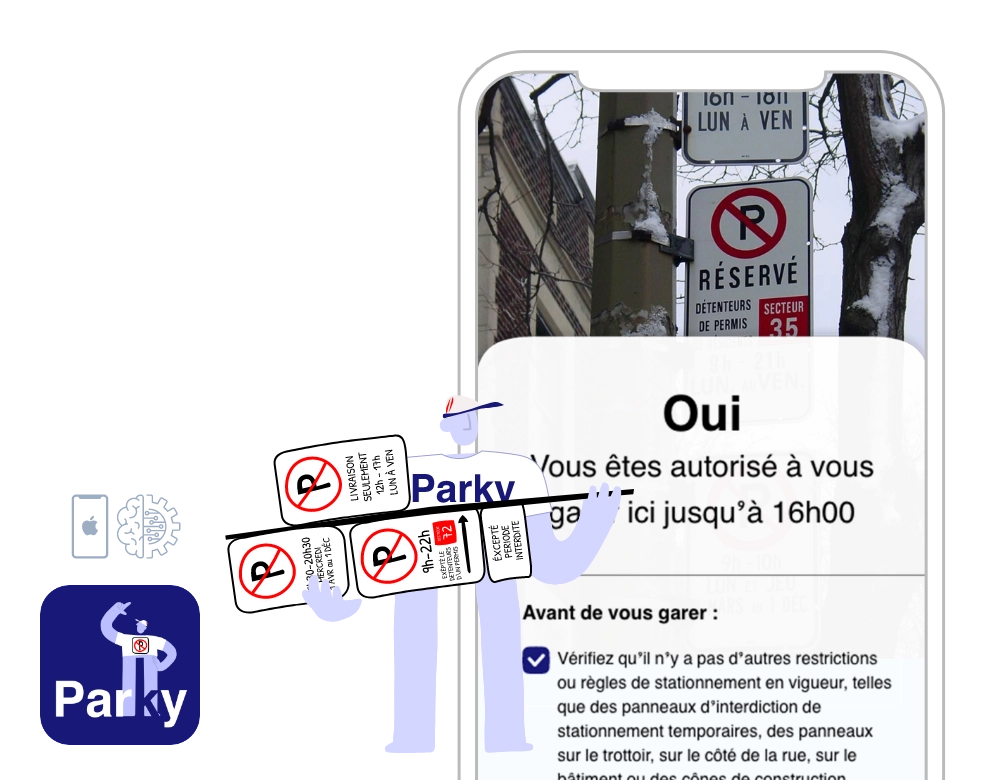
The mobile flow captures a sign, processes its information through AI models and presents a user-oriented explanation.
Grounded outcome
AI is attached to a specific real-world task instead of presented as a general-purpose chat interface.
Product and Underlabs’ role
Parky.AI addresses Montréal’s layered parking rules through an AI-enabled mobile product. Underlabs developed the iOS and Android interpretation platform and evaluated recognition and reasoning approaches. The mobile application connects to backend model processing and returns an explanation for a specific parking decision.
From image to an explainable answer
The driver photographs the complete sign stack. The system structures rules, symbols, directional arrows, permits, dates and times, then evaluates visible conditions against the current day and time. The result explains why parking is or is not permitted. When the image does not support a reliable conclusion, the product can return “Not sure”.
User experience and supported result
The documented flow does not require an account or device location: the captured signs and current date and time supply the decision context. The product began with Montréal parking complexity and expanded to signs from other municipalities. Its operational result is an inspectable conclusion and explanation rather than text recognition alone. Exact model versions, measured accuracy and current retention guarantees are not asserted here.
This case study uses only information publicly documented by Underlabs. No unverified performance metric is presented.
Next project
Organize-it!
A mobile inventory system for finding stored objects through photos, tags, locations and NFC.